
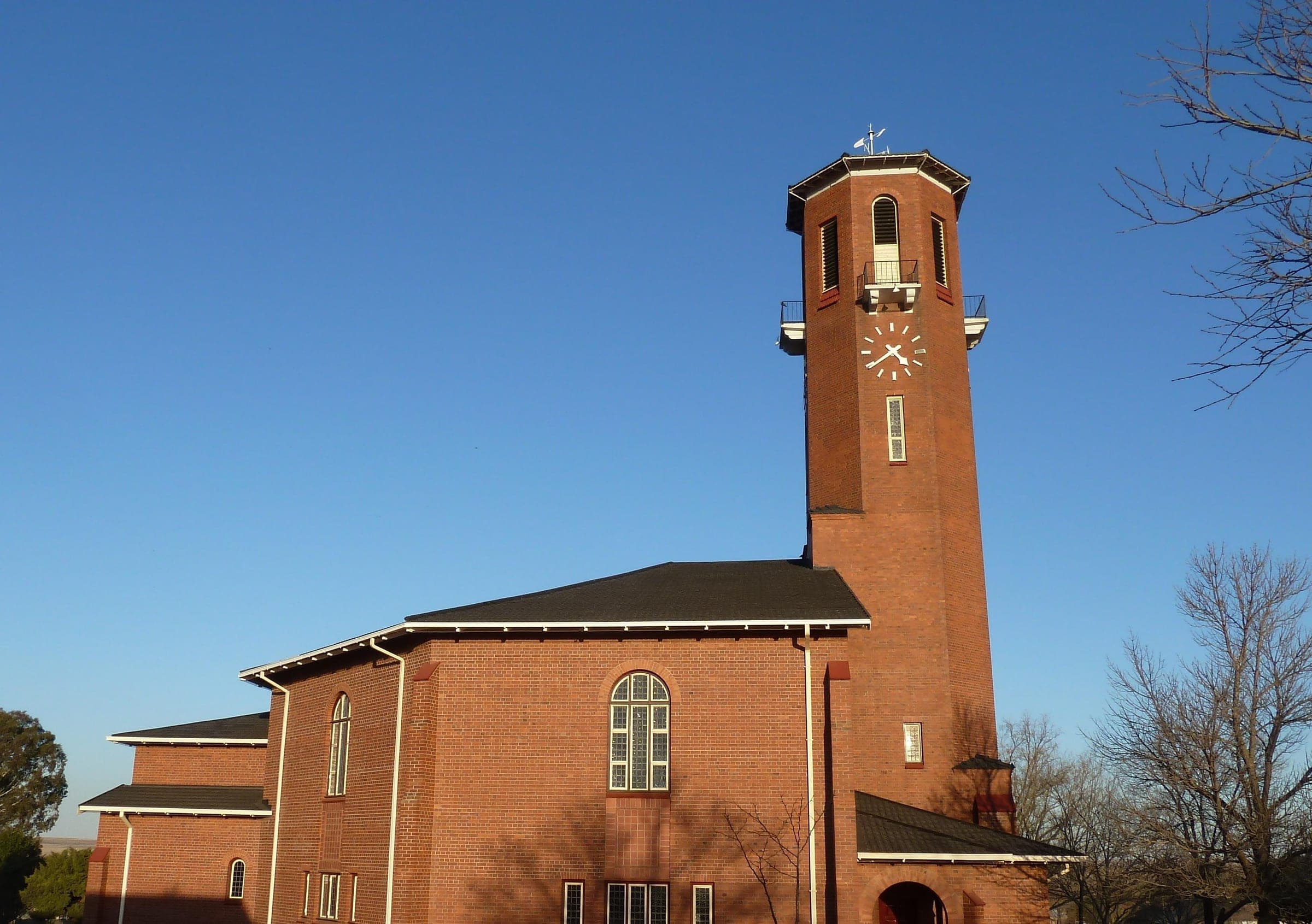
Reformed church management is the work of a council of elders that governs the church under a church order. Continental Reformed churches call this council the consistory, Presbyterian churches call it the session, and Afrikaans churches call it the kerkraad. Generic church software has a different model, in which a pastor leads the church with staff and volunteers.
So a Reformed church needs records that generic software does not keep. Examples are offices with terms, elders' districts, home visits, profession of faith, transfers between churches and notes by office.
This guide lists what such a church needs, where the church orders ask for it, and how to test a system. Scripture comes first. Then come two families of church order: the Church Order of Dort (1619) and the Westminster Form of Presbyterial Church-Government (1645), with their descendants. The examples come from five federations:
- the Canadian Reformed Churches (CanRC), Church Order of 2025;
- the United Reformed Churches in North America (URCNA), Church Order of 2024;
- the Gereformeerde Kerke in Suid-Afrika (GKSA), Kerkorde in the 2015 print;
- the Orthodox Presbyterian Church (OPC), Form of Government (FG);
- the Presbyterian Church in America (PCA), Book of Church Order (BCO) of 2025.
Your federation has its own church order and its own numbers. Check each point in your own text.
Contents13 sections
Who governs a Reformed church?
The New Testament shows elders in every church (Acts 14:23; Titus 1:5) and deacons who serve those in need (Acts 6:1-6). Dort puts a consistory of the ministers and the elders in every church (art. 37). The Westminster form names pastors, teachers, other church-governors and deacons. It adds: "Which officers reformed churches commonly call Elders."
The modern orders keep this pattern. The consistory is the ministers and the elders (CanRC, art. 38; URCNA, art. 21). The session is the pastor, the other ministers and the elders (OPC, FG XIII.4; PCA, BCO 12-1). The deacons are not members, but some orders add them when the elders are few (Dort, art. 38; CanRC, art. 39).
The government belongs to the assembly, not to one person. The elders act one by one and together (OPC, FG X.3; PCA, BCO 8-3). A GKSA commentary says that one elder may do pastoral work alone, but only the elders together govern (Handleiding by die Kerkorde, 1965, p. 145). So access to a member's record follows the office and the district, not a staff job title. The council decides who reads what, not the software vendor.
What does a Reformed church need that generic church software misses?
Offices with dated terms
The terms of office differ. In 1619, elders and deacons served two years, and half retired each year (Dort, art. 27). In the CanRC, they serve two or more years, and a proportionate number retires each year (art. 24). The URCNA consistory sets the term (art. 13). An OPC congregation chooses service for life or terms of three years (FG XXV.2).
In the PCA, ordination is for life, but the session can release an elder from the active duties (BCO 24-7). So a system must keep each period of service with a start date and an end date. A single "role" field cannot show the office apart from the active term.
Elders' districts (wards)
Each church order in this guide sends the elders to visit the members. The CanRC elders visit the members "in their homes to comfort, instruct, and admonish them" (art. 22). The URCNA elders visit the members "according to their needs" (art. 14). The OPC and the PCA elders visit the people, especially the sick (FG X.3; BCO 8-3).
A church can divide the members among the elders. In the GKSA, for example, each elder gets a ward and gives account of it to the council (Acta 1952:220-221). So a system must link each household to one district, and each district to its elders and deacons.
Home visits and the Lord's Supper
Dort ties house visitation to the Lord's Supper: "both before and after the Lord's Supper", as circumstances permit (art. 23). In 1619 the Supper came every two months, where possible (art. 63). The CanRC and the URCNA hold it at least every three months (CanRC, art. 60; URCNA, art. 46). In the PCA, the session sets the times (BCO 58-1).
None of these orders sets a number of visits per year. Many churches aim to visit every household each year, as a practice, not a rule. A system must show which households had a visit and which did not. Read the elder's home visit.
Baptism and profession of faith in the register
The OPC names two kinds of member: communicant members, who made a credible profession of faith, and noncommunicant members, their baptised children (FG XIII.2). Only those who made profession of faith come to the Lord's Supper (Dort, art. 61; CanRC, art. 61; URCNA, art. 45).
Dort names one register: the baptised, the parents, the witnesses and the date (art. 60). The modern orders ask for more. The CanRC records the dates of birth, baptism, profession of faith, marriage, and departure or death (art. 64). The PCA records baptisms, communicant and non-communicant members, deaths and dismissions (BCO 12-8). So a field "member: yes or no" is not enough. Read the member register.
Transfers between churches
A member who moves gets a testimony for the new church. Dort calls it a certificate of dismission, under the church seal or signed by two (art. 82). The CanRC calls it an attestation, signed for the consistory by two of its members (art. 62). The OPC clerk sends a letter, and the old church removes the name only when the new church reports the date of reception (FG XIII.9). In the PCA, the member stays under the old session until the member joins the new church (BCO 46-3).
So a system must follow the transfer through both churches, with the dates. An "inactive" flag does not show where the member went, or when the letter left. Read the attestation.
Annual figures for the broader assembly
Each year the OPC presbytery reports the members received and dismissed, and the deaths, to the general assembly (FG XIV.6). In the GKSA, the number of members with a profession of faith in each church is the basis of the synod assessment (Acta 2023:112). Check what your federation asks for each year.
A council that reads reports
The deacons give account of their work to the council (Dort, art. 25; CanRC, art. 42; URCNA, art. 15). The OPC deacons submit their records to the session every three months (FG XI.5). The PCA session examines the deacons' records and approves the budget (BCO 12-5).
The council's own records also go up. Presbyterian sessions send their minutes to the presbytery for review at least once a year (FG XIII.8; BCO 12-7). In continental churches, church visitors from the classis visit the council (CanRC, art. 46; URCNA, art. 27). So a system must make a report for a period and a district with little work. A deacons' report must never name the members that the deacons help (Handleiding, p. 158).
Confidentiality by office
Some knowledge must not even reach the council. A secret sin that the sinner repents of after private admonition does not go to the consistory (Dort, art. 73; URCNA, art. 53). The first public announcement in discipline does not give the name (Dort, art. 77; CanRC, art. 68). The GKSA commentary calls the home visit official, but private and confidential, pastoral care (Handleiding, p. 147).
So the elders and the deacons need different access to notes. A system must let the writer choose who reads each note. Data protection law also applies, and differs by country. Read pastoral notes and visit records for what to write down.
How do you test a system for a Reformed church?
Ask these questions in a demo, with your own church's data where you can.
- Can it hold each period of office with a start date and an end date?
- Does each household belong to one district, with its elders and deacons?
- Can an elder see which households in the district had no visit this year?
- Does the register hold baptism and profession of faith, each with a date?
- Can the office request, release and receive a transfer, and keep the dates?
- Does a membership end with a reason, such as "left with attestation" or "deceased"?
- Can the writer of a note choose who reads it: the elders only, or the elders and the deacons?
- Can an administrator with no office read pastoral notes? The answer must be no.
Generic church software is the right choice for some churches. A church that needs child check-in, attendance at services or room reservations needs those tools. The guide for Reformed and Presbyterian churches compares the kinds of product. South African readers can use the South African buyer's guide.
How Reformeer does it
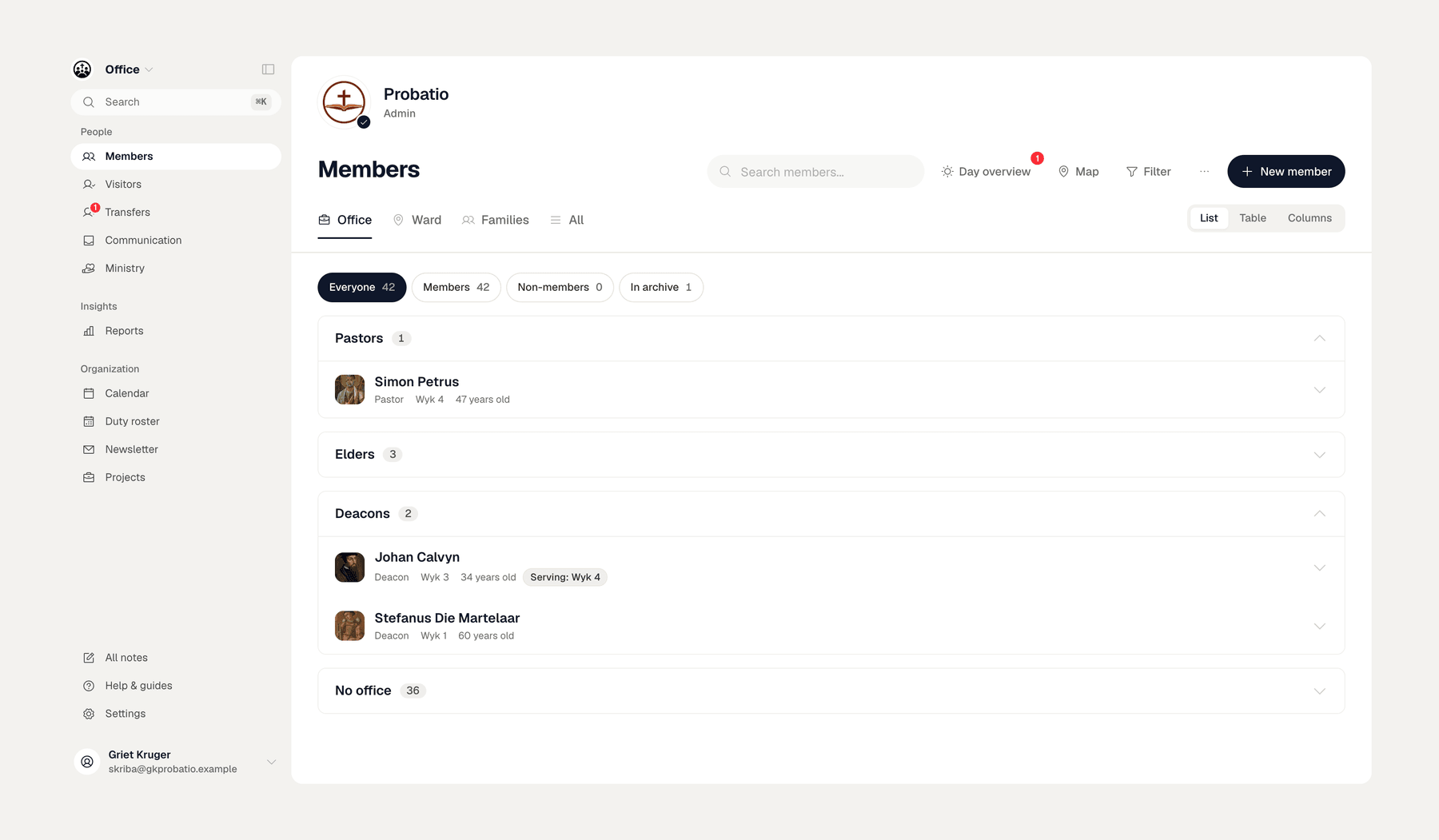
Reformeer is church management software for Reformed and Presbyterian churches. Its office app, Kantoor, covers the needs above:
- Offices. A person can hold the office of elder, deacon or pastor, with dated office periods.
- Wards. Reformeer calls a district a ward. A ward has its elders, its deacons and other persons, such as a ward sister.
- Visits. A visit is a note of the kind Visit. The Day overview shows Not yet visited: the households in the officer's own wards with no visit note this church year.
- Transfers. The new church chooses Request a transfer, the member's current church releases the member, and the new church accepts. A church that is not on Reformeer gets the request by email. The Attestation letter PDF covers one member or a whole family, and you choose the signatories.
- The register. Baptism and profession of faith each have a status and a date. Membership periods have a join reason and an exit reason.
- Annual statistics. The Annual statistics tab counts the members for a church year (1 April to 31 March). It shows the additions and departures by reason, as Excel or JSON.
- Note tiers. The writer chooses Elders only, Elders and deacons, a ministry group, or Administrative. The author always reads their own note. An admin with no office never reads pastoral notes.
The limits: Reformeer has no tool for meetings, agendas or minutes. The clerk writes the minutes in another program and uploads the file to the council documents. The baptism record has no place, minister or witnesses. The church year starts on 1 April, and the screens are in Afrikaans and English. Outside South Africa, two more limits apply today. The finance app (Finansies) keeps the books in rand (ZAR), and card gifts go through Paystack.
The price is per church, not per member: R995 per month in South Africa and $99 per month in the US (see the prices). See the office features, or book a demo.
kantoor.reformeer.org
Frequently asked questions
What is Reformed church management?
It is the administration of a church that a council of elders governs under a church order. The council keeps the offices, the districts, the registers and the transfers.
Is a session the same as a consistory?
Both are the body that governs the local church: the ministers and the elders. Continental churches say consistory, and Presbyterian churches say session. The deacons are members of neither, but some continental orders add them when the elders are few (CanRC, art. 39).
Does the church order say which records a council must keep?
Dort names only the baptism register (art. 60). Modern orders list more, for example the CanRC (art. 64), the URCNA (art. 50) and the PCA (BCO 12-7, 12-8). Read what the church order asks of the council.
Must an elder visit every household once a year?
None of the church orders in this guide sets a number. Dort ties the visits to the Lord's Supper (art. 23), and the others ask the elders to visit the members. Many churches aim for one visit per household each year, as a practice.
Published on 23 October 2026. Topic: Church management.