
In a Reformed or Presbyterian church, elders govern the church in a council, under a church order. Church management software for such a church must keep the records that the church order asks for. These are the roll of members by baptism and profession of faith, the elders' districts and visits, the deacons' work and the transfers between churches. Reformeer is church management software built for this kind of church. It costs $99 per month per church in the United States and R995 per month in South Africa, with unlimited users.
This guide is for church offices, elders and deacons in any country. For a church in South Africa, read the South Africa buyer's guide.
Contents7 sections
Why does a church with elders need different software?
Scripture gives the care of the church to elders (Acts 20:17-28, 1 Peter 5:1-4). It gives the care of the needy to deacons (Acts 6:1-6, 1 Timothy 3:8-13). Two historic families of church order put this into rules:
- The continental Reformed family. The Church Order of Dort (1618-1619) has 86 articles and dates from 28 May 1619. Its descendants include the church orders of the GKSA (South Africa), the Canadian Reformed Churches (CanRC) and the United Reformed Churches in North America (URCNA).
- The Presbyterian family. The General Assembly of the Church of Scotland approved the Westminster Form of Presbyterial Church-Government on 10 February 1645. Today each Presbyterian church has its own book of church order or constitution. Examples are the Orthodox Presbyterian Church (OPC), the Presbyterian Church in America (PCA) and the Igreja Presbiteriana do Brasil (IPB).
The two families use different words for the same things. This guide uses one neutral word for each:
| This guide says | Continental Reformed | Presbyterian | Afrikaans churches |
|---|---|---|---|
| the council | the consistory | the session (conselho in the IPB) | the kerkraad |
| the regional assembly | the classis | the presbytery | the klassis |
| the transfer of membership | the attestation | the certificate of dismission (PCA), the carta de transferência (IPB) | the attestaat |
Elders also visit the members at home. Many continental churches call this family visitation, and Afrikaans churches call it huisbesoek.
Generic church software starts from a different model: a pastor who leads a team of staff and volunteers. It often does attendance and child check-in well. These are real needs, but they are not the needs of a council that answers to a church order.
What does the church order ask the council to record?
Each church order has its own numbers and words. The table shows one example from each family, from the federations' own published texts. Check the same duty in your own church order.
| Duty of the council | Continental example | Presbyterian example | What the software must do |
|---|---|---|---|
| Keep the roll of members | CanRC (2025), art. 64: the dates of birth, baptism, public profession of faith, marriage, and departure or death | PCA Book of Church Order (2026), 12-8: baptisms, "communing members", "non-communing members", deaths and dismissions | Keep these dates per person |
| Give account to the regional assembly | CanRC, art. 46: church visitors visit the churches each year | OPC Form of Government, XIII.8: the session submits its minutes to the presbytery at least once every year | Keep council documents and yearly figures in one place |
| Transfer a member | CanRC, art. 62: an attestation, signed for the consistory by two of its members | PCA Book of Church Order, 46-1: a certificate of dismission from the session | Send a letter, and change the roll at both churches |
| Care for the needy | CanRC, art. 23: deacons gather and manage the offerings and give them out to those in need | IPB, art. 83(g): the conselho sets up and guides the board of deacons (Junta Diaconal) | Keep funds apart, and limit who reads each note |
The Church Order of Dort set the same duties in 1619. Its article 23 sends the elders to visit the members, before and after the Lord's Supper. The CanRC order also tells the elders to visit the members in their homes (art. 22). For a walk through the articles, read what the church order asks of the council.
Church visitation is a continental practice: in the CanRC, classis sends at least two experienced ministers to the churches each year (art. 46). Presbyterian churches have a different check. The presbytery reviews the records of the session, in the PCA at least once a year (Book of Church Order 12-7 and 40-1). See church visitation.
A 12-point checklist for any Reformed or Presbyterian church
Generic church software is often weak on points 1 to 7 and point 10. Score each product on each point: 0 is no, 1 is partly, 2 is yes. Print the list and take it to each demo.
- Roll of members. Households, baptism and profession dates, and a history of each change. The roll keeps baptised children apart from communicant members, as the CanRC, OPC, PCA and IPB orders do. See the member register.
- Membership periods. A start date and an end date, each with a reason: baptism, profession, transfer, death.
- Offices. Elders, deacons and ministers with dated terms.
- Districts. Each household belongs to a district with its own elders and deacons.
- Visits and follow-ups. Visit notes, open follow-ups, and the homes that nobody visited this year. See the elder's home visit.
- Who reads a note. Access by office and by district, with a separate login for each person. See pastoral notes.
- Transfers. The old church releases the member, the new church receives the member, and both rolls change. See the attestation.
- The books. Double-entry books in your currency, with the deacons' funds kept apart. See church finances.
- Gifts and statements. How members give in your country, and the gift statement that your tax law asks for.
- Statistics. Figures for the classis or presbytery, for the period that it asks for. The IPB, for example, tells each conselho to keep the church's statistics and send them on (art. 83(j), art. 70(l)).
- Data law and data location. Roles, a change history, backups, and the country where the vendor keeps the data.
- Language, migration and exit. The languages of the screens, who moves your data in, and how you get it out again.
Which data law applies to church records?
CAUTION: This section is not legal advice. Data law differs by country. Ask an adviser in your own country before you decide what to record.
A church roll shows the religious belief of each member, and a pastoral note can show health details. Many data laws give such data extra protection:
| Country | Law | What it says about religious data |
|---|---|---|
| South Africa | POPIA (Act 4 of 2013) | Religious belief and health are special personal information (section 26). A religious organisation may process the religious beliefs of its own members (section 28). |
| European Union and United Kingdom | GDPR and UK GDPR, article 9 | Religious beliefs and health data are special categories. A not-for-profit body with a religious aim may process the data of its members, former members and regular contacts, with safeguards, and not disclose it without consent (article 9(2)(d)). |
| Brazil | LGPD (Law 13,709 of 2018) | Religious conviction is sensitive personal data (article 5, II). Article 11 lists the grounds to process it, and the first is specific consent. |
| United States | No single federal privacy law | Congress has passed laws for some sectors, and at least 19 states have their own consumer privacy laws (Congressional Research Service, 2025). |
In the United States, a donor needs a written acknowledgment from the church for any single gift of $250 or more (IRS Publication 1771). It states the amount, and whether the church gave goods or services in return. One annual statement can cover several gifts.
What does it cost, and what must you ask a vendor?
Vendors charge per member, per user, or a flat price per church. A price per user can push a council to share one login, and then nobody can tell who read a pastoral note. Reformeer has a flat price per church with unlimited users. It costs $99 per month in the United States, or $149 with the church website. In South Africa it costs R995 per month, or R1 495 with the church website.
Ask each vendor these questions, and get each answer in an email:
- What is the price in our currency, and what does each extra cost?
- In which country do you keep our data and backups, and which other companies process it?
- Who can read a pastoral note: an administrator with no office, or your own staff?
- Can the software hold our offices, districts and transfers as our church order describes them?
- How do members give online in our country, and into whose bank account does the money go?
- Who does the data migration, and can we take all our data out if we leave?
- Is there a contract, and do you offer two-factor sign-in?
How Reformeer does it
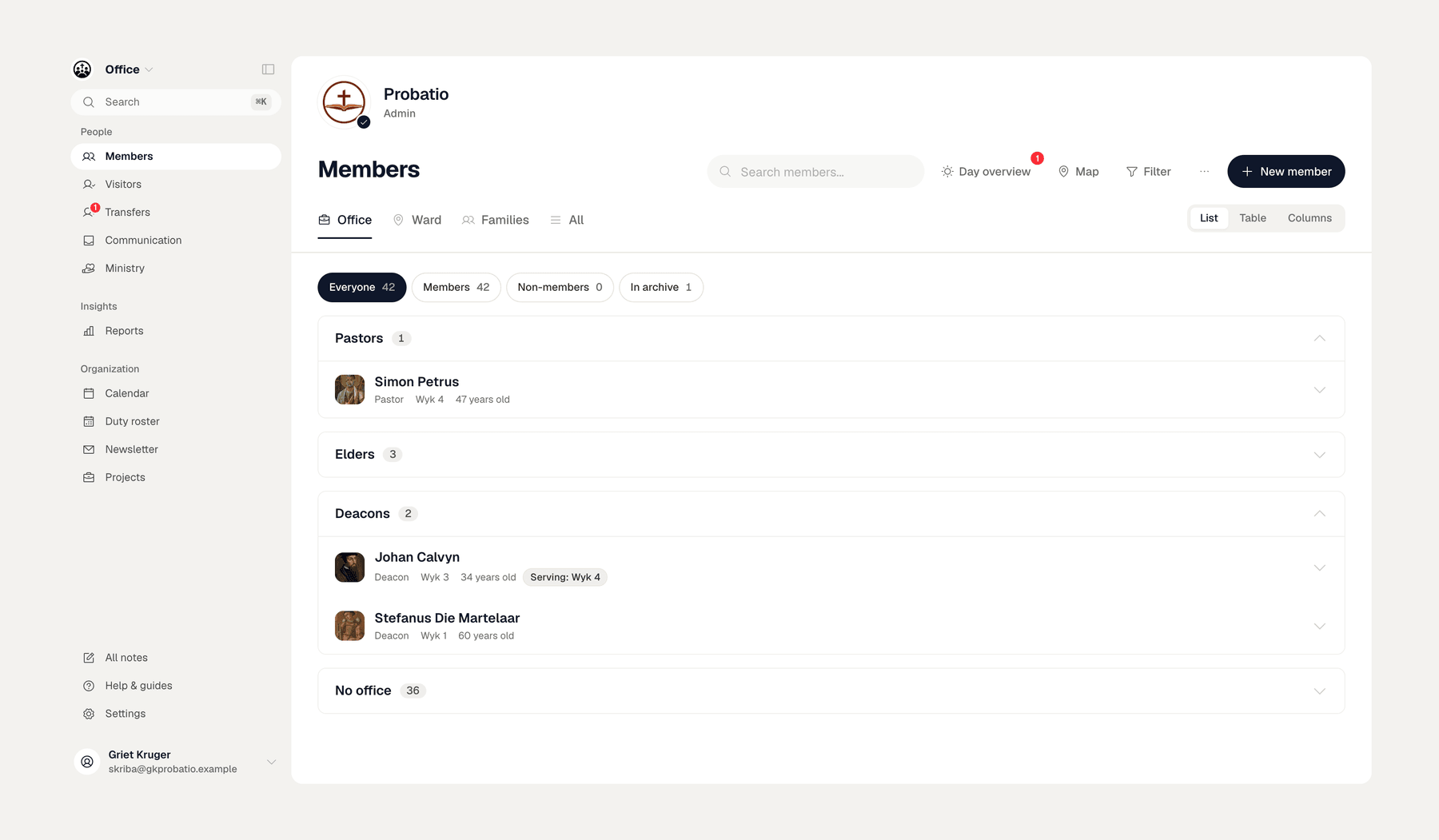
Reformeer has three web apps: Kantoor (the church office), Finansies (the church books) and the member app at www.reformeer.org.
- Roll and offices (points 1 to 3). Households, baptism and profession dates, membership periods with join and exit reasons, offices with dated periods, and custom fields.
- Districts, visits and notes (points 4 to 6). Reformeer calls a district a ward. The Day overview lists the households in your wards with no visit note this church year. The writer of a note chooses who reads it: Elders only, Elders and deacons, a ministry group, or Administrative. An administrator with no office never reads pastoral notes.
- Transfers (point 7). The new church requests a transfer, and the old church releases the member. A church that is not on Reformeer gets the request by email. The attestation letter is a PDF.
- The books (point 8). The double-entry ledger refuses a transaction that does not balance, also per fund. It has a budget, a council report and read-only access for the auditor.
- Statistics (point 10). Annual statistics give the membership figures, with additions and departures by reason.
- Data and migration (points 11 and 12). The database and the files are in Belgium (Google Cloud), and the applications run in Germany (Vercel). Reformeer AI runs at Anthropic in the United States. The Reformeer team imports your export (Excel, CSV and similar) in about 1 to 2 days.
Know these limits before you choose, especially outside South Africa:
- The screens are in Afrikaans and English only.
- Finansies keeps the books in rand (ZAR) only. A church with books in another currency needs other software for the books.
- Online gifts in the app are card gifts in rand through Paystack. They are not an option for a church in the United States or Brazil.
- The annual statistics and the Day overview count a church year from 1 April to 31 March. If your classis or presbytery asks for figures by calendar year, check this in a demo.
- The council uploads its minutes as files: there is no tool for agendas or minutes. There is no child check-in, no attendance at services, no room booking, no payroll and no two-factor sign-in.
See the prices, read about Kantoor and Reformeer AI, or book a demo.
kantoor.reformeer.org
Frequently asked questions
What is the best church management software for a Reformed or Presbyterian church?
The best fit follows your church order: the council, offices with terms, districts, transfers and confidential notes by office. Reformeer is built for a church that elders govern under a church order.
Is there church management software for a consistory or a session?
Yes. Look for software that keeps the roll, the offices, the districts, the visit notes and the council documents in one place, with access by office. Reformeer does this for a consistory, a session or a kerkraad, but the council uploads its minutes as files.
How much does Reformeer cost in the United States?
Reformeer costs $99 per month per church in the United States, with unlimited users. With the church website, it costs $149 per month.
Can a church outside South Africa use Reformeer?
Yes, for the roll, the wards, pastoral notes, visitors, transfers, the duty roster, the calendar and the AI. The screens are in Afrikaans and English, Finansies keeps the books in rand, and online gifts go through Paystack in rand.
Published on 23 October 2026. Topic: Church management.