
In Reformed and Presbyterian churches, the deacons collect the gifts for those in need and give them out. The council (the consistory or the session) governs the church and supervises the deacons, and a treasurer keeps the books under its authority. Four controls keep the money safe: an approved budget, a recorded decision before each payment, a monthly bank reconciliation and an independent review each year.
Church orders differ, so this post compares several of them. Check each article number in your own church order. The law also differs by country, so ask your own accountant or adviser.
Contents13 sections
What do the church orders say about the deacons?
In Acts 6:1-6, some widows did not get their share of the daily distribution. The apostles asked the church to choose seven men for this work, and gave themselves to prayer and to the ministry of the word. Both historic families of church order give the care of the poor to the deacons.
The Church Order of Dort (1619), art. 25, tells the deacons "diligently to collect alms and other contributions of charity, and after mutual counsel, to distribute the same faithfully and diligently to the poor". They "shall render an account in Consistory". The Westminster Form of Presbyterial Church-Government (1645) says that the office of the deacon is "to take special care in distributing to the necessities of the poor".
Modern church orders add detail:
| Church order | Article | The deacons and the money |
|---|---|---|
| Church Order of Dort (1619) | art. 25 | Collect the alms, distribute them after mutual counsel, and render an account in the consistory |
| GKSA Kerkorde (South Africa) | art. 25 (text of 1997) | Collect the gifts of love with care, spend them with wisdom, and report in the council |
| Canadian Reformed Churches (2025) | art. 23, 42 | Gather and manage the offerings, distribute them to those in need, and give account to the consistory |
| United Reformed Churches in North America (10th edition) | art. 15 | Gather and manage the offerings, meet as a rule at least once a month, and render an account to the consistory |
| Orthodox Presbyterian Church | Form of Government, ch. XI | Collect and disburse funds for the needy, keep a record of all funds, and submit it to the session every three months |
| Presbyterian Church in America (2026) | Book of Church Order 9-2, 9-4 | Collect and distribute the gifts, care for the church property, and submit the minutes to the session |
| Igreja Presbiteriana do Brasil | Constituição, art. 53 | Collect offerings for pious purposes, care for the poor and the sick, under the supervision of the council |
Two points are common. The deacons give account to the council, and the council supervises their work. The scope can change: in 1927 the GKSA synod limited its deacons to the care of the poor (Acta 1997, p. 588).
Who is responsible for the general finances?
The general finances pay for the minister, the building and the other work. The church orders give them to different bodies:
- The PCA. The deacons care for the property, and their board elects a treasurer for the current expenses (BCO 9-2, 9-4). The session examines the deacons' records and approves and adopts the budget (BCO 12-5).
- The OPC. The session supervises the deacons and the board of trustees. It has final authority over the use of the property (Form of Government, ch. XIII.7). A church may keep a corporation with trustees for the property matters that the civil law requires (ch. XXXI).
- The IPB. The council (Conselho) governs and administers the church. It elects a treasurer each year, preferably an officer of the church (Constituição, art. 8 and art. 84).
- The URCNA. Each congregation owns its property, and the consistory makes the decisions about it (art. 33).
- The GKSA. We found no article in the Kerkorde on the general finances, a budget or an audit. The council acts for the church in matters of property (Kerkordeboekie, bylae "Naam en eiendom van die kerke").
The treasurer
Dort 1619, the GKSA, the CanRC and the URCNA create no office of treasurer. A council that appoints a treasurer gives that person a task, and the council stays responsible. Some Presbyterian orders name one, such as the PCA (BCO 9-4) and the IPB (art. 84).
What rules keep church money safe?
The church orders give the principle: account to the council. Practical guidance adds the rules. One example is the Handleiding by die Kerkorde (1965), a respected GKSA commentary, which is not church law.
- A decision before the payment. The Handleiding says that a payment without a decision in the minutes is not authorised (Handl. p. 157).
- A record of all funds. The OPC and the PCA tell the deacons to keep a record of all funds and their distribution (OPC ch. XI.5; PCA BCO 9-4).
- No names in the report. The deacons' report gives the number of cases and the amounts, but never the names of the members who get help (Handl. p. 158).
- One set of statements. The diaconal account, without personal detail, goes into the balance sheet of the church (Handl. p. 255).
- Two people for each payment. One person prepares the payment, and a second person approves it. No church order that we read says this, but it protects the treasurer.
- Separate funds. A fund is money kept for a purpose, such as the diaconal fund or a building fund. Keep each fund apart.
What does the law ask of a church?
The duties depend on the country and on the legal form of the church. These examples come from official sources, but they are not complete.
South Africa
- Since 1 April 2023, a nonprofit organisation must register under the Nonprofit Organisations Act if it makes donations or provides services outside South Africa (s12(1)). For other churches, registration is voluntary.
- A registered NPO draws up financial statements within six months after its financial year. Within two months after that, it gets a written report from an accounting officer (s17). This report is not a full audit.
- We found no statute that requires an audit of a church that is only a voluntary association. This is a negative result, so confirm it for your own church.
- SARS says that tithes and offerings for the religious activities of a church do not qualify for a section 18A deduction (guide IT26).
The United States
- A church that meets the requirements of section 501(c)(3) is automatically tax exempt. It does not have to apply for recognition (IRS Publication 1828).
- Churches do not have to file Form 990, 990-EZ or 990-N. They must keep the books and records that justify the exemption (Publication 1828).
- For a single gift of $250 or more, the donor needs a contemporaneous written acknowledgment from the church. It gives the name of the church and the amount. It says if the church gave goods or services in return, with a good-faith estimate of their value. If the church gave nothing, or only intangible religious benefits, it says so (Publication 1771).
- One annual statement can cover several gifts. Gifts of less than $250 are not added together (Publication 1771).
- A payment of more than $75 that is partly a gift and partly for goods or services needs a written disclosure statement (Publication 1828).
Canada
- A registered charity files the T3010 return no later than six months after the end of its fiscal period (Canada Revenue Agency).
- An official donation receipt must show set information. Examples are the CRA registration number, a unique serial number and the eligible amount of the gift (Canada Revenue Agency).
Other countries, such as the UK, Australia and Brazil, have their own rules.
CAUTION: Ask your accountant before you put tax words on a statement or a receipt.
A checklist for the treasurer and the council
No church order that we read lists the duties of the treasurer. These checklists are good practice.
Each month
- Bring all bank transactions for the month into the books.
- Link each gift to the member and to the fund.
- Reconcile each bank account with the bank statement.
- Check that each payment has a decision in the minutes, a proof document and two approvals.
- Compare the income and the expenses with the budget, fund by fund.
- Give the council a report: the budget against the actual figures, the balance of each fund and the bank balances.
- Let the deacons give account to the council, with no names.
- Close the month, so that nobody changes it later.
Each year
- Reconcile each bank account with the last statement of the financial year.
- Draw up an income and expenditure statement and a balance sheet, with the diaconal account in them.
- Give each member a statement of their gifts for the year, with the tax words that your country requires.
- Arrange the independent review or the audit.
- File the returns that your country requires, by their dates.
- Write the budget for the next year, and let the council approve it.
- After each election of office-bearers, update who may sign and who may approve payments.
- Check the membership numbers. In the GKSA, the synod assessment uses the number of confessing members (Acta 2023:112). Read the member register and church records.
The broader assemblies also look at this work. At each GKSA classis, the chair asks whether the poor get care (art. 41). A PCA presbytery reviews the session's records each year (BCO 40-1). Read how to prepare for church visitation.
How does Reformeer keep the church books?
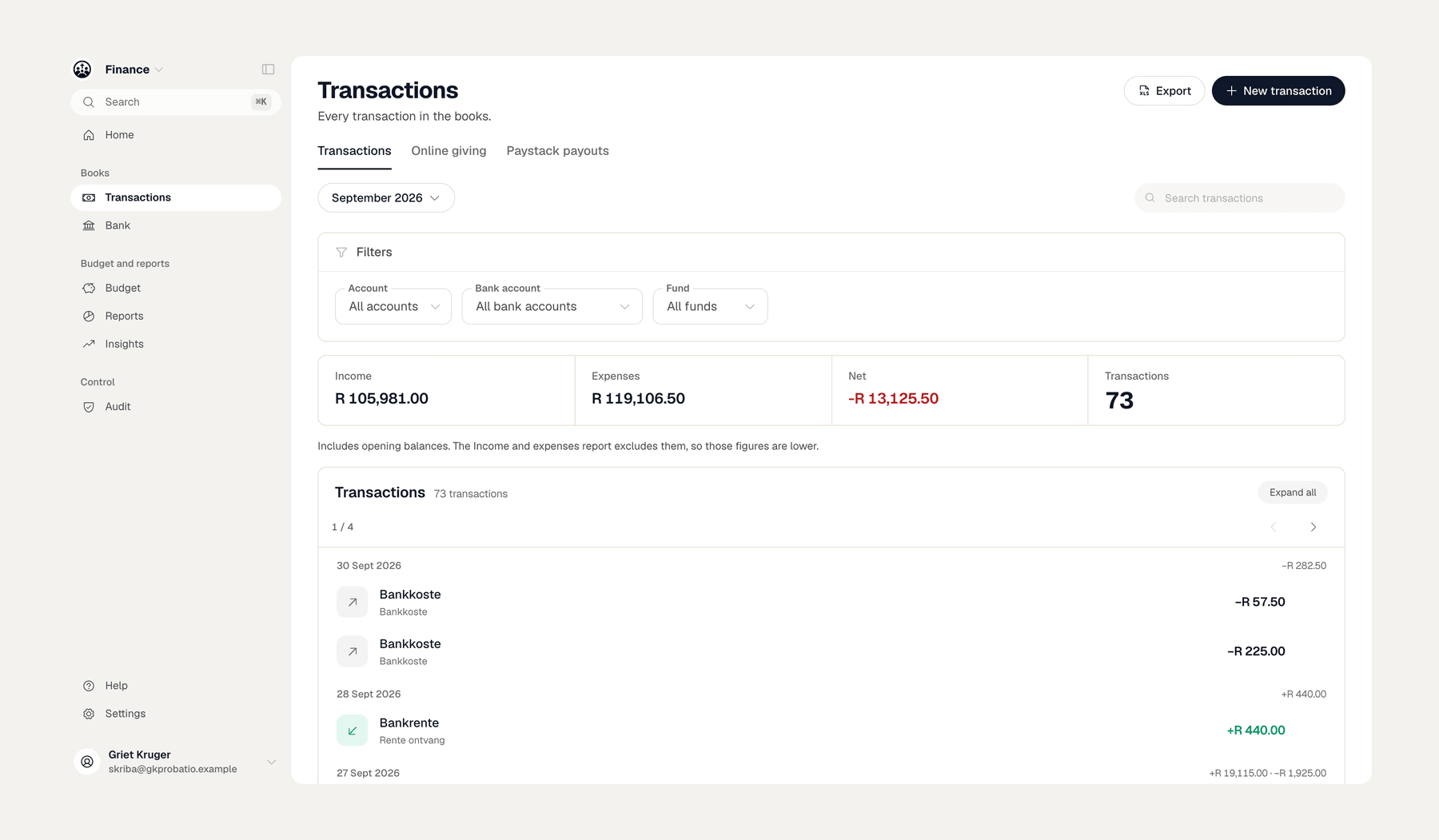
Finansies is the Reformeer app for the church books.
- Double-entry with funds. Each transaction has two or more legs. The server refuses legs that do not balance, also per fund.
- The bank-statement import. Finansies imports the bank statement as PDF, CSV, XLS or XLSX. It suggests the account, the fund and the member for each line, and a finance person approves each line. So gifts by bank transfer and debit order reach each member's contribution statement without a second entry.
- The reconciliation, the budget and the reports. Reconcile each bank account month by month. The budget (Begroting) starts from the last 12 months, and approval locks it. The council report (Kerkraadverslag) is a PDF.
- Month close and auditor access. A closed month locks its transactions. An auditor gets read-only access to the trial balance, the journal, the change log and the deleted transactions.
The limits are important outside South Africa. Finansies keeps the books in rand (ZAR) today, and gifts in the app are card gifts through Paystack. The contribution statement has no tax words, so it does not replace an IRS acknowledgment or a Canadian official receipt. Finansies has no bank feeds, payroll or invoices. A church in another country can still use the register, the pastoral care and the other office tools.
Reformeer costs R995 per month per church in South Africa and $99 per month per church in the United States, with unlimited users. Read more on Finansies and the prices, or book a demo.
finansies.reformeer.org
Frequently asked questions
Who is responsible for church finances in a Reformed church?
The council (the consistory or the session) is responsible, and it supervises the deacons. The deacons care for the poor, and in some federations also for the offerings and the property. A treasurer does the work for the council.
Are church offerings tax-deductible?
It depends on the country. In South Africa, SARS says that tithes and offerings for religious activities do not qualify for a section 18A deduction. In the United States, gifts to a church are generally tax-deductible (IRS Publication 1828). A single gift of $250 or more needs a written acknowledgment.
Does a church need an audit?
Most church orders that we read do not require an audit. The law can require a report or an audit, for example for a registered NPO in South Africa. An independent review each year protects the treasurer and the deacons, so ask your accountant.
Published on 23 October 2026. Topic: Finances.