
Church visitation (kerkvisitasie) is a practice of the continental Reformed churches. The classis sends at least two experienced office-bearers to each church in the classis. They ask whether the office-bearers serve faithfully, keep to sound doctrine and the church order, and build up the congregation. Presbyterian churches reach the same aim in another way: the presbytery reviews the records of each session every year, and it can visit a church.
Contents9 sections
What is church visitation?
The Church Order of Dort (1619), art. 44, tells the classis to appoint "at least two of the oldest, most experienced and competent" ministers "to visit all the Churches once a year". They must "take heed whether the Ministers, Consistories, and School-teachers faithfully perform the duties of their offices, adhere to sound doctrine, observe in all things the adopted order".
The descendants of Dort keep the task, but they change who goes and how often:
| Church order | Who visits | How often |
|---|---|---|
| Church Order of Dort (1619), art. 44 | At least two ministers | Once a year |
| GKSA Kerkorde, art. 44 | At least two ministers | "Gereeld" (regularly) |
| Canadian Reformed Churches (2025), art. 46 | At least two ministers | Each year, with a written report to classis |
| URCNA Church Order (10th edition), art. 27 | Two experienced office-bearers: two ministers, or a minister and an elder | Once every two years |
| NHK Kerkorde (2022), Ordinance 4.2.2 | A committee of at least one minister, one elder and one deacon | Each year |
The GKSA replaced "every year" with "regularly" in 1964. Its commentary, the Handleiding by die Kerkorde (1965), says that a rural classis can use a rotation of two or three years (p. 273). Check the current text of your own church order.
The visitors advise. They do not govern: in the words of the Canadian Reformed order, they "fraternally admonish" and help "by their good counsel and advice" (art. 46). They report to the classis, and the classis decides. In the GKSA, the council must follow the advice that the classis adopts. It keeps the right of appeal in art. 31 (Handleiding, p. 276). For the other duties of the council, see what the church order asks of the council.
Where does church visitation come from?
The Handleiding finds the principle in Scripture (Acts 15:22–31; 2 Corinthians 8:22). Paul's words to Barnabas show the same care: "Let us go again and visit our brethren in every city where we have preached the word of the LORD, and see how they do" (Acts 15:36, KJV).
The Reformed churches were careful at first, because bishops used visitation to control their churches. In 1586 the Dutch churches made provision for an annual visitation by the classis. The Synod of Dort (1618–1619) made it compulsory (Handleiding, p. 270).
Is there a Presbyterian counterpart?
The OPC, PCA and IPB books of church order have no standing church visitors. They give the presbytery two other tools.
- The annual review of records. The OPC session submits its minutes and the minutes of the congregation to the presbytery "for review at least once every year" (Form of Government XIII.8). The PCA session submits its record "at least once in every year to the inspection of the Presbytery" (BCO 12-7). In the Igreja Presbiteriana do Brasil (IPB), the presbytery examines the minutes of each session, the conselho (Constituição, art. 88).
- The power to visit. The OPC presbytery has the power "to visit particular churches for the purpose of inquiring into their state" (Form of Government XIV.5). The PCA (BCO 13-9) and the IPB (art. 88) give the presbytery the same power. In the PCA, a commission of at least two ministers and two ruling elders can visit a part of the church "affected with disorder" (BCO 15-2).
The PCA lists four questions for the review of records (BCO 40-2):
- Whether the proceedings have been correctly recorded.
- Whether they have been regular and in accordance with the Constitution.
- Whether they have been wise, equitable and suited to promote the welfare of the Church.
- Whether the lawful injunctions of the higher court have been obeyed.
A review reads the records. A visitation is a conversation with the council. Both serve the same aim: the wider church keeps watch over each local church.
What do the church visitors ask?
At each classis meeting, the chair asks each church a few questions. The Canadian Reformed order asks three (art. 44). The GKSA asks four (art. 41):
- Does the council meet?
- Does it exercise discipline?
- Does it care for the poor and the schools?
- Does it need the help of the classis?
For the visit itself, the GKSA prints a "possible guide" of twelve questions (Acta 1955:185). It is one example of a visitation guide:
- Are there two services on the Lord's Day, and do the members attend well?
- Is there one catechism sermon every Sunday?
- Are there catechism classes, and do the parents teach the catechism at home?
- Are the sermons simple and in agreement with God's Word?
- Are children baptised as soon as possible?
- Do the council members make regular home visits and visits to the sick?
- Does the council meet regularly, especially before the Lord's Supper, for mutual censure?
- Is the Lord's Supper held regularly, with proper preparation and discipline?
- Are the poor cared for properly, and how?
- What is the state of the education of the youth?
- What does the church do for mission and evangelism, in money and otherwise?
- Does the church need the advice or the help of the classis?
A classis uses its own visitation regulation, or gives its visitors a defined task (Handleiding, p. 275). The NHK builds the agenda on the joint annual report of the church (Ordinance 4.2.2). Ask your classis for its regulation before you prepare.
Is church visitation an audit?
The orders differ here. The NHK committee checks the administrative books of the church (Ordinance 4.2.2). In the GKSA tradition, a 1954 report quotes H. Bouwman: "Er is volstrekt geen sprake in artikel 44 van een administratief of statistisch onderzoek" (Kerkordeboekie, p. 47). In short: article 44 asks for no administrative or statistical inquiry. Have the records ready, but expect a conversation about the life of the church.
How should a council prepare for church visitation?
The church orders do not list the records that a council must show. The checklist below is practical advice. Make the clerk (the scriba) or the church administrator responsible for it.
CAUTION: Do not put the names in a discipline case into papers that circulate. A pastoral note is the record of a confidential visit, so leave the notes out of the papers too.
| When | What to do | Topic |
|---|---|---|
| Three months before | Ask the classis for its visitation regulation and the date. | All |
| Three months before | Make sure that the minutes of the council and of the deacons are complete and approved. | Council meetings |
| Three months before | Bring the registers up to date: baptisms, professions of faith, transfers in and out, and members who moved without a transfer. | Registers |
| Three months before | Ask each elder for the home visits and sick visits in their district this year. | Home visits |
| One month before | Get the catechism report: the classes and the attendance. | Catechism |
| One month before | Get the deacons' report without names: the number of cases, the kind of help, and the money in and out. | Care of the poor |
| One month before | Prepare the financial statements and the budget against actual. | Finances |
| One month before | List the dates of the Lord's Supper, and the council meetings before each one. | Lord's Supper |
| One month before | Announce the visitation, and tell the members how they can speak to the visitors. | All |
| The week before | Write down the matters on which the council wants the advice of the classis. | Help of classis |
| The week before | Put the documents for the visitors in one folder. | All |
| After | Read the report of the visitors. If a fact is wrong, say so at the classis. | All |
For a Presbyterian session: the annual review
- Make sure that the minutes are complete and approved.
- Record the sacraments and the changes in membership in the minutes (OPC Form of Government XIII.8).
- Bring the rolls up to date: baptisms, communing and non-communing members, deaths and dismissions (PCA BCO 12-8).
- Read your own minutes against the four review questions of BCO 40-2.
- Send the minutes to the presbytery on time. In the OPC, send the minutes of the congregation too.
For the records behind the questions, see the elder's home visit, the member register, church attestation and church finances.
How does Reformeer help a council prepare?
Reformeer keeps most of the records that the questions touch.
- Home visits. The ward planner (Ward planning, on the Reports page) shows per ward the elders, the deacons, the visits this church year, the open follow-ups and the catechism percentage. You can download it as an Excel file. A visit is a note of the kind Visit, so the count comes from the notes that elders already write.
- Catechism. The catechism roll call keeps each lesson with present, absent or excused.
- The registers. Each person has baptism and confession dates, and membership periods with a join reason and an exit reason. The annual statistics give the membership figures for a church year, with additions and departures by reason.
- Finances. Finansies gives the council report as a PDF, and reports for income and expenses, the balance sheet and the budget against actual, as a PDF or an Excel file.
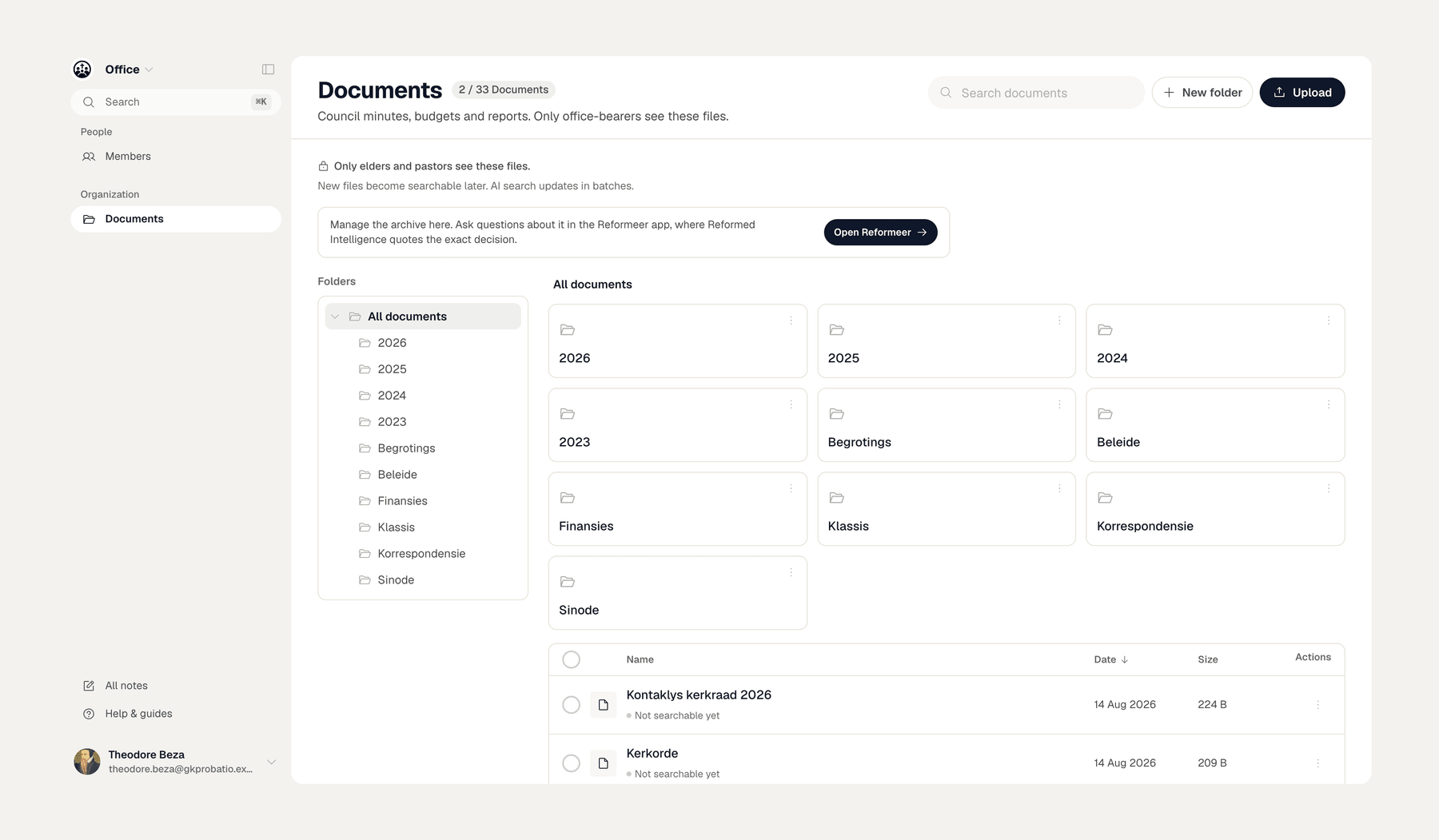
- Council documents. The minutes and the reports go into folders of PDF and Word files. Active elders and pastors can search them.
The limits: Reformeer has no tool for agendas or minutes, so minutes are files that the clerk uploads. The church year in the statistics runs from 1 April to 31 March. Finansies keeps the books in rand (ZAR) today, and the screens are in Afrikaans and English. Do not give the visitors a sign-in: download the reports that they need. See the office app and Finansies, or book a demo.
kantoor.reformeer.org
Frequently asked questions
How often does church visitation take place?
It depends on the order. The Church Order of Dort and the Canadian Reformed order say each year, and the URCNA order says once every two years. The GKSA order says "regularly", and each classis sets its own programme.
Who are the church visitors?
Most orders send experienced ministers whom the classis appoints. The URCNA also allows a minister and an elder, and the NHK sends a committee with a minister, an elder and a deacon.
Do Presbyterian churches have church visitation?
Not by that name in the OPC, PCA and IPB orders. The presbytery reviews the minutes of each session at least once a year. It also has the power to visit a church to inquire into its state (OPC Form of Government XIV.5; PCA BCO 13-9).
What happens after the visitation?
The visitors report to the classis, and the classis decides on the report. In the GKSA, the council must follow the advice of the classis, but it keeps the right of appeal in art. 31.
Published on 23 October 2026. Topic: Church order.